
If your adhesive bead is inconsistent, your cycle times are too long, or you’re constantly dealing with dripping and stringing between shots — the problem often isn’t the adhesive. It’s the gun.
Selecting the right adhesive dispensing gun is one of the most overlooked steps in setting up a dispensing system. Most buyers focus on the pump or the controller, but the gun is the last point of contact before the adhesive hits the substrate. Get it wrong, and everything upstream stops mattering.
This guide walks through the main gun types, key selection criteria, and the questions you should be asking before you specify one.
Why the Dispensing Gun Matters More Than People Think
In a well-designed dispensing system, the gun does three things:
- Opens and closes the adhesive flow on command
- Seals cleanly between shots (no drip, no stringing)
- Delivers a consistent bead geometry at the required flow rate
In automotive applications specifically — door hem flange sealing, windshield bonding, underbody coating, weld seam sealing — the gun operates at high cycle rates, often 60–120 shots per minute, with very tight bead tolerances (±0.5 mm or better). Under those conditions, even a marginal gun choice creates quality problems that scale fast.
Main Types of Adhesive Dispensing Guns
1. Pneumatic Needle Valve Guns
The most common type in general industrial dispensing. A pneumatic actuator opens and closes a needle valve against a seat, controlling flow.
Best for: Medium-viscosity adhesives, moderate cycle rates, dot and bead dispensing Typical applications: Electronics assembly, general automotive trim bonding Limitations: Valve response time limits maximum cycle frequency; requires clean, dry air supply
2. Electric Needle Valve Guns
Replace the pneumatic actuator with a servo or voice coil motor. This allows much faster and more precise valve control.
Best for: High-speed dispensing, precision dot dispensing, closed-loop flow control Typical applications: High-volume automotive assembly lines, EV battery module bonding Advantages over pneumatic: Faster response, programmable stroke control, no compressed air dependency at the gun head Limitations: Higher unit cost; requires compatible controller
3. Gear Pump Dispensing Guns (Integrated Pump-Gun)
Some configurations integrate a small gear pump directly into the gun body, eliminating the separate pump-to-gun fluid line. The pump meters the fluid; the valve simply opens and closes.
Best for: High-viscosity materials, continuous bead dispensing at steady flow rates Typical applications: Structural adhesive bonding, seam sealing with thick materials Limitations: Heavier gun head; not ideal for very short dot shots
4. Jetting Valves
Non-contact dispensing: the adhesive is ejected as a jet without the gun touching the substrate. No needle-to-seat contact during dispensing.
Best for: Very small dots, high-speed dot arrays, circuit board underfill Typical applications: Electronics manufacturing; less common in heavy industrial automotive Limitations: Limited to lower-viscosity materials; more sensitive to adhesive rheology changes
5. Extrusion Guns (Manual and Semi-Automatic)
Handheld or fixture-mounted guns that push adhesive out by mechanical or pneumatic pressure against a cartridge or bulk container.
Best for: Low-volume production, maintenance and repair applications, prototype assembly Typical applications: Aftermarket automotive repair, small-batch manufacturing Limitations: Not suitable for automated high-volume production
Key Specifications to Evaluate
When specifying a dispensing gun, these are the parameters that determine whether it will actually work in your application:
Fluid Inlet Pressure Rating
The gun must handle the maximum system pressure from your pump. For most automotive structural adhesive applications, this means 100–300 bar. Confirm the gun’s rated working pressure and its burst pressure safety margin.
Cycle Frequency (Shots Per Minute)
How fast does the valve need to open and close? A pneumatic needle valve typically maxes out around 300–600 cycles/minute. Electric jetting valves can reach 1,000+ cycles/minute. Match the gun to your actual production cycle requirement, with margin.
Minimum Shot Volume
If you’re dispensing small dots, the gun must be capable of reliably delivering your minimum shot volume with consistency. Jetting valves handle microliters; standard needle valves are better suited to 0.1 ml and above.
Wetted Material Compatibility
Every surface that contacts the adhesive — the needle, seat, body, seals — must be chemically compatible with your adhesive chemistry (epoxy, polyurethane, MS polymer, silicone, etc.). For aggressive materials, PTFE-lined internals and 316L stainless steel wetted parts are standard.
Temperature Range
For hot-melt and heated adhesive systems, the gun must maintain a consistent heated zone. Confirm the gun’s maximum operating temperature and the uniformity of its heating element.
Nozzle / Tip Configuration
Bead geometry is determined largely by nozzle design. Round tips for standard beads; flat-fan nozzles for wide coverage; custom profiles for specific flange geometries. Check whether the manufacturer offers interchangeable tips for your gun body.
Common Mistakes in Gun Selection
Undersizing the pressure rating. Operators sometimes select a gun rated for lower pressures and then push the system harder than spec. This causes premature wear on the needle and seat and eventually leaks.
Ignoring cycle life ratings. A gun rated for 500,000 cycles will fail quickly on a line running 2 million cycles per year. Always ask for the rated cycle life and plan your maintenance intervals accordingly.
Mismatching viscosity to gun type. Jetting valves don’t work with high-viscosity pastes. Needle valves don’t deliver consistent micro-dots for electronics. Understand the viscosity range your gun type is designed for.
Overlooking seal compatibility. Standard Buna-N (NBR) seals are not compatible with many modern adhesive formulations. Confirm seal material compatibility — PTFE or Viton seals are often required for automotive-grade adhesives.
Choosing the cheapest nozzle. The nozzle wears fastest of any gun component. A precision-machined nozzle from a quality manufacturer will maintain bead geometry for far more cycles than a low-tolerance stamped tip. The nozzle is not the place to cut cost.
Matching the Gun to the Full System
A dispensing gun doesn’t operate in isolation. It works downstream of a pump and upstream of the substrate. The three components need to be matched:
Pump flow rate → Gun inlet capacity: If the pump can deliver more material than the gun can accept at its rated pressure, you’ll see pressure spikes, valve bounce, or bead inconsistency.
Controller signal timing → Gun response time: The controller needs to fire the gun open and closed with precise timing. Pneumatic guns have a lag between the electrical signal and actual valve movement (typically 20–50 ms). Electric guns respond in under 5 ms. If your controller timing is calibrated for electric and you install a pneumatic gun, your beads will be placed incorrectly.
Fluid viscosity + temperature → Nozzle sizing: Flow through the nozzle follows fluid dynamics that depend heavily on viscosity, which changes with temperature. If your adhesive temperature varies by more than ±5°C, bead volume will drift — either add temperature control or account for this in your process window.
Hongguang Dispensing Guns: Technical Overview
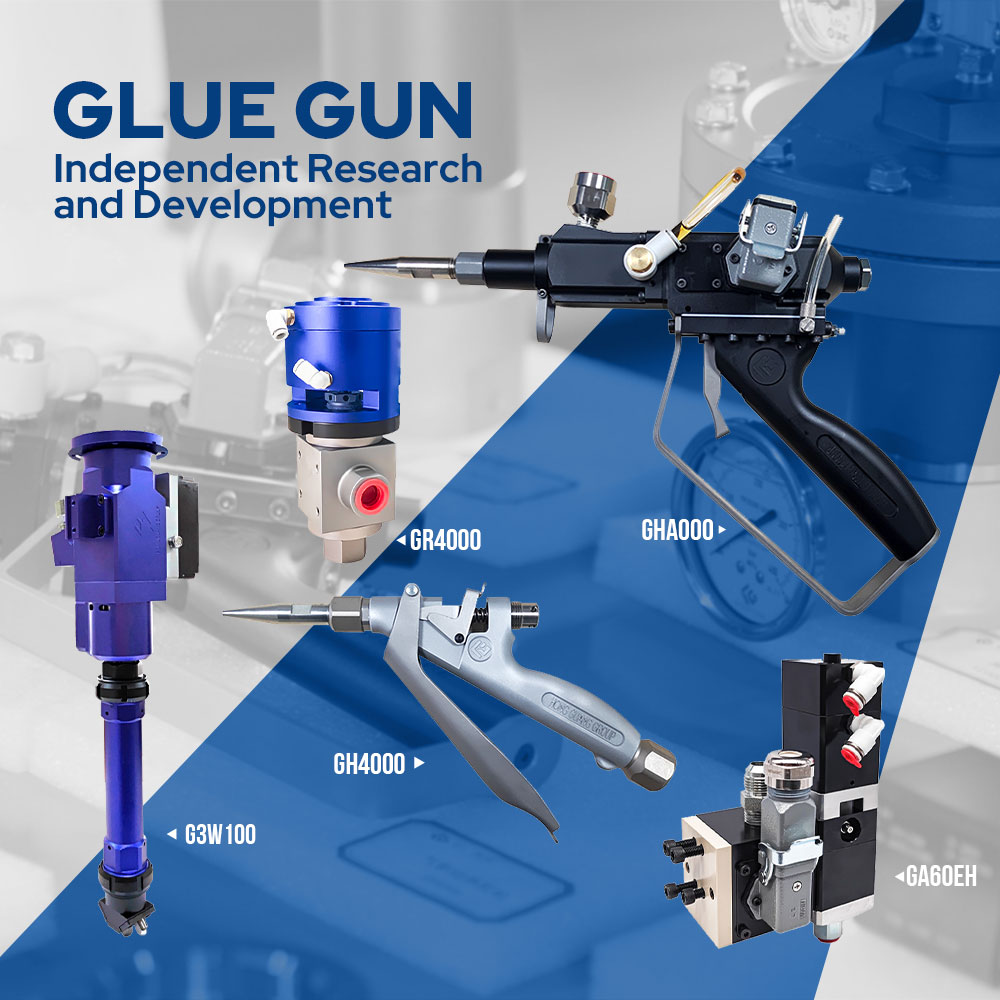
Hongguang manufactures needle valve dispensing guns and integrated gun assemblies for automotive and industrial adhesive applications. Our standard product specifications:
- Wetted materials: 316L stainless steel body; PTFE seals standard; Viton available on request
- Working pressure: Up to 250 bar
- Rated cycle life: 2,000,000+ cycles (standard needle/seat configuration)
- Temperature range: Ambient to 120°C (heated models available to 180°C)
- Nozzle interface: Standard 1/4-28 UNF and M6 thread; custom profiles available
- Seal replacement interval: 500,000 cycles under standard conditions (with recommended adhesive compatibility)
- Compatible pump systems: Direct interface with Hongguang gear pump series; adaptable to most major OEM pump platforms
We supply guns as standalone components and as part of complete dispensing assemblies (pump + controller + gun + mounting bracket). Application-specific configurations available for automotive OEM and Tier 1 supplier environments.
Lead time: 3–5 business days for standard configurations; 7–10 days for custom nozzle profiles.
FAQ
Q: Can I use your dispensing gun with my existing pump from another manufacturer? A: In most cases, yes. Our guns use standard fluid inlet connections (G1/4, G3/8, or NPT 1/4 depending on model). Send us your pump outlet specs and we’ll confirm compatibility or provide an adapter.
Q: What’s the minimum order quantity for automotive supply? A: We supply single units for qualification and testing. Volume pricing applies at 10 units and above. There is no minimum order quantity for standard catalog items.
Q: How do I know if my current gun is causing my bead inconsistency? A: The fastest diagnostic is to run your system at a fixed pressure and time the gun open for a fixed duration, then weigh the output. If the shot-to-shot weight variation exceeds ±2%, the gun (or its associated seal/needle wear) is the likely cause. We can help you interpret results if you send us your test data.
Q: Do you offer application engineering support for gun selection? A: Yes. Send us your adhesive type, viscosity, application temperature, required bead dimensions, and cycle rate. We’ll recommend a gun configuration and, where needed, can provide a test unit for line qualification.
Q: What is the typical seal replacement cost? A: Seal kits for our standard guns are stocked and priced at a fraction of the gun cost. Most customers budget one seal kit per 500,000 cycles as a planned maintenance item. We can provide a 12-month spare parts kit recommendation based on your production volume.
Next Steps
If you’re specifying a dispensing gun for a new line or looking to replace an underperforming gun in an existing system, send us your application parameters and we’ll come back to you within 24 hours with a recommendation.
Required information:
- Adhesive type and viscosity (at application temperature)
- Required bead width and height (or dot diameter and volume)
- Cycle rate (shots per minute)
- System working pressure
- Any existing equipment the gun needs to interface with